


My Number Card Japan:
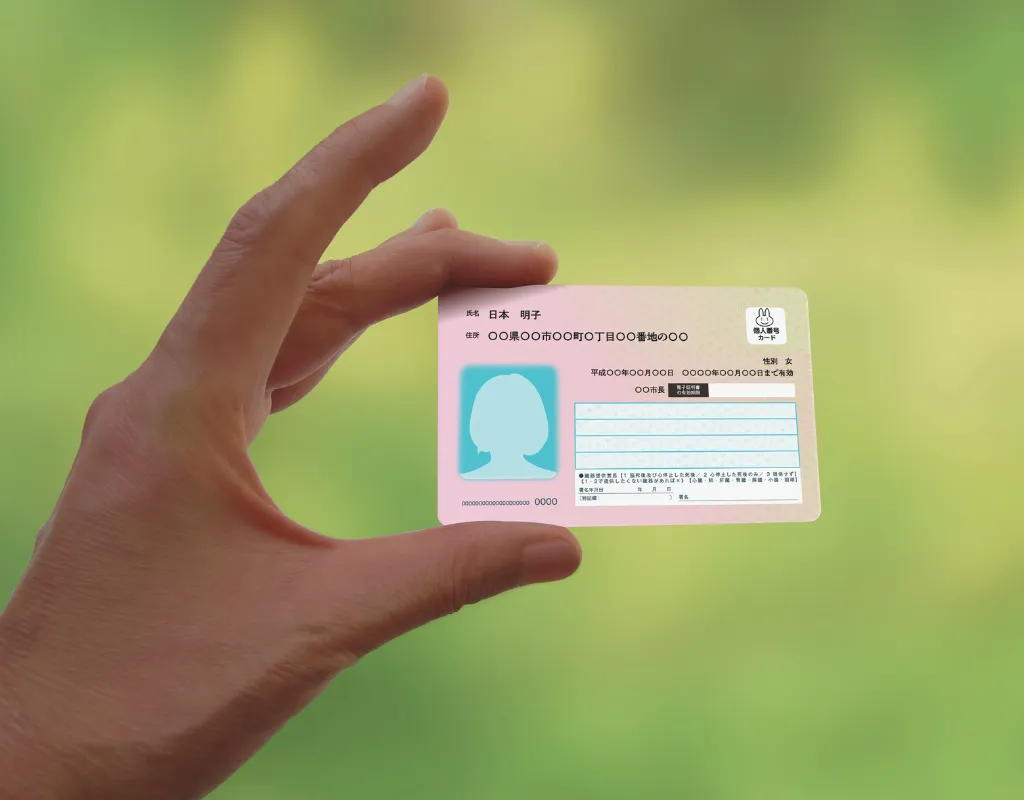
My Number Card in Japan is an official identification card that contains your unique 12-digit “My Number.” This number is used by the Japanese government to identify individuals for administrative, tax, and social security purposes. The card is more than just a photo ID—it also works as a digital certificate, allowing you to submit tax returns, apply for government services, and complete other procedures online.
A My Number Card is available to anyone with a registered residence (住民票 / jūminhyō) in Japan. Since every resident is issued a 12-digit My Number, foreign residents can also apply for and receive a card. For long-term residents, understanding how the My Number Card works is essential to making everyday life in Japan smoother and more convenient.
In this guide, Certified Financial Planner Lili Katoh explains everything you need to know about the My Number Card in Japan—from the basics of what it is, to how to apply for one step by step.
Update: Important Changes in 2025-2026 The Japanese government has announced significant updates regarding the My Number Card and Residence Card. Starting in 2025 and 2026, these cards will be integrated to simplify procedures for foreign residents. Read on to learn about the new “Special Residence Card” and how it affects you.
About the Supervisor & Writer
Certified Financial Planner®
Founder of Money Step Office Inc.
Lili Katoh specializes in insurance, life planning, and asset management. She is a Health Management Expert Advisor and author of “Setai Nenshū 1000 Man En” and “Gattsuri Tamaru Chokin Recipe”. Born in California, USA, she brings international insight to Japanese financial planning.
Who This Article Is For
This guide is intended for foreign residents in Japan who:
Want to understand the My Number Card Japan system and how it can simplify daily life.
Are considering applying for a My Number Card and want clear, step-by-step instructions.
Need guidance on using the card for identification, healthcare, taxes, and online government services.
Table of Contents
Chapter 1: What is the My Number Card in Japan?
My Number Card Japan is a plastic identification card that contains personal information such as your name, address, date of birth, and gender, along with a unique 12-digit “My Number” assigned to each resident. The card includes a facial photo, which makes it valid as an official identification document—similar to a passport or driver’s license—when proof of identity is required.
Inside the card is an embedded IC chip that stores personal data. This chip enables the card to function as a digital certificate for online administrative procedures, such as submitting applications or tax filings through e-Gov services.
Applying for a My Number Card is optional, but for those who choose to do so, issuance is free of charge. There are no fees required to create or receive the card.
If you own an Android smartphone or iPhone, you can also register the card’s digital certificate to your device. This allows you to access some of the card’s electronic functions directly on your smartphone, adding convenience to daily life in Japan.
References: Digital Agency. About My Number Card. Retrieved September 29, 2025, from Digital Agency – About My Number Card
1.1. Differences Between a Residence Card and a My Number Card
A Residence Card
A Residence Card is issued to foreigners entering Japan who hold a mid- to long-term residence status, allowing stays longer than three months. It is officially issued by the Immigration Services Agency of Japan. The card is processed either at local immigration offices or at the airport upon entry, if the foreign national qualifies for a mid- to long-term residence status. Residence Cards are issued to all eligible individuals, and those aged 16 or older are required to carry the card at all times within Japan.
The card displays personal information, including name, date of birth, nationality, address, type of residence status, and period of stay, along with a facial photograph. Its validity is generally tied to the expiration date of the holder’s residence period.
My Number Card
In contrast, a My Number Card is issued to individuals with a registered residence in Japan (住民票 / jūminhyō) upon their request. Applications are processed at the municipal office in the holder’s registered address. Unlike the Residence Card, the My Number Card is optional; there is no obligation to apply for or carry it.
The My Number Card displays the holder’s name, date of birth, address, and a facial photograph. Its validity usually corresponds to the expiration date of the holder’s residence period. However, for permanent residents, holders of the Highly Skilled Professional (Type 2) visa, and Special Permanent Residents, the card is valid until the holder’s 10th birthday after the issuance date, similar to the validity rules for Japanese citizens.
Related Post
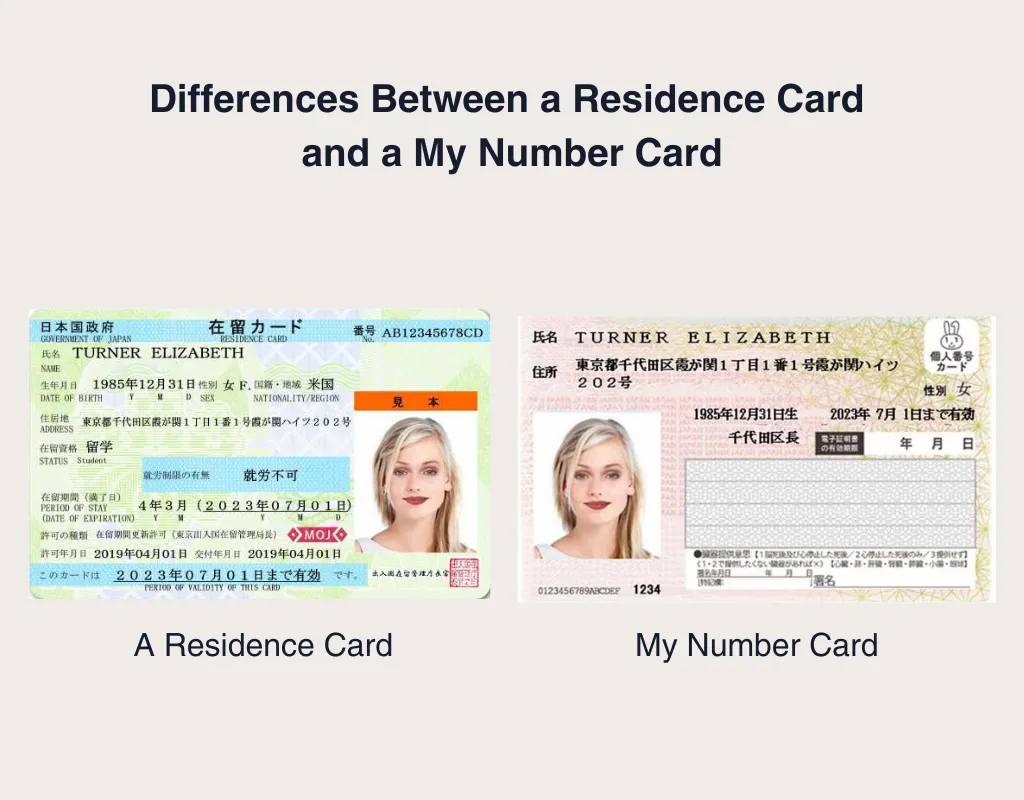
This image was created based on reference information provided by the Immigration Services Agency of Japan (PDF: https://www.moj.go.jp/isa/content/001420065.pdf)
1.2. Differences Between the Individual Number Notification Card and the My Number Card
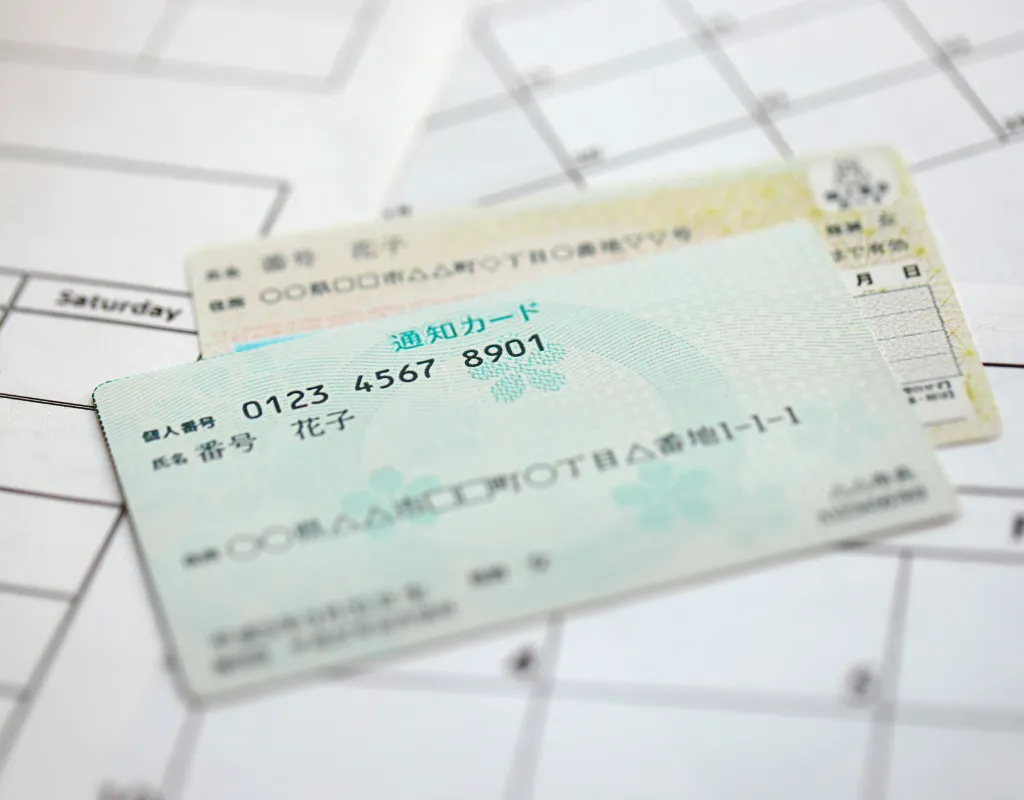
The Individual Number Notification Card and the Individual Number Notification Document are official documents used to notify each resident of their unique My Number. These documents include personal information such as name, date of birth, and the My Number itself. They do not include a photograph. Until May 24, 2020, the document issued was called the “Individual Number Notification Card (個人番号通知カード / Kojin Bangō Tsūchi Kādo),” and from May 25, 2020 onward, it has been issued as the “Individual Number Notification Document (個人番号通知書 / Kojin Bangō Tsūchisho).”
Both documents are paper-based. Once a resident submits a notification of address change and is registered on the municipal resident registry (住民票 / jūminhyō), the documents are mailed by the local municipal office within approximately two to three weeks.
If an Individual Number Notification Card has already been issued, it can still be used for identity verification only if the name and address have not changed. However, it must be presented together with another form of official ID, such as a passport or driver’s license. Note that when applying for a My Number Card, the Notification Card must be returned.
The Individual Number Notification Document cannot be used as an official identity verification document. When this document is mailed, it includes a form called the “Application for Issuance of My Number Card” (個人番号カード交付申請書), which residents use to apply for a My Number Card at their municipal office.
Chapter 2: What Can You Do with a My Number Card in Japan?
Obtaining a My Number Card Japan allows you to use it as an official identification document in various situations, making administrative procedures and daily life more efficient.
Identity Verification
The My Number Card can be presented whenever proof of identity is required, functioning like a passport or driver’s license.
Access Official Documents at Convenience Stores
You can obtain copies of official documents issued by your municipal office—such as a resident certificate (住民票 / jūminhyō), seal registration certificate, and tax certificate—directly from multifunctional copy machines at convenience stores nationwide.
Local Government Web Portal
Online Residence Procedures
If you have a My Number Card, you can apply for residence-related procedures online. After applying, your residence card can be mailed to you, and in some cases, you can receive the Certificate of Eligibility electronically.
Immigration Services Online Application
Using the My Number Portal (Requires Prior Registration)
By registering in advance, you can access the My Number Portal (マイナポータル), an online administrative service linked to your My Number. Through the portal, you can manage your personal information, handle procedures related to moving, check or register your health insurance card, view medical and prescription records, access pension records, and even integrate with the income tax e-filing system.
Procedures for Moving (Requires Prior Registration)
When moving, you must submit a notice of moving out (転出届 / tenshutsu todoke) to your old municipality and a notice of moving in (転入届 / tennyū todoke) to your new municipality. With a My Number Card, you can submit the moving-out notice online via the My Number Portal. While you still need to visit the new municipal office in person to submit your moving-in notice, the shared information helps streamline the process.
Moving Procedures via My Number Portal
Using the My Number Card as a Health Insurance Card (MyNa Health Card; Requires Prior Registration)
By registering in advance on the My Number Portal, your My Number Card can serve as a health insurance card, called the MyNa Health Card (マイナ保険証). You can use it at hospitals and pharmacies even without a physical health insurance card.
Since September 19, 2025, the MyNa Health Card can also be used on smartphones. By registering the card’s digital certificate and completing portal registration, you can use your smartphone as a health insurance card at participating medical institutions.
Note: For employees who receive a health insurance card from their employer, that card is valid until December 2025. After that, newly issued Eligibility Confirmation Certificates or the MyNa Health Card will be used.
Receiving Public Funds (Benefits) (Requires Prior Registration)
By registering your bank account in advance on the My Number Portal, you can receive government or municipal benefits directly into your account. This eliminates the need to submit bank account information or attach copies of passbooks when claiming benefits.
Income Tax Electronic Filing (Requires Prior Registration)
For income tax filing, linking the My Number Portal with the e-Tax system allows your personal information—such as name and address—to be automatically entered in your tax forms. You can also link relevant certificates digitally, significantly reducing the effort required for filing.
Chapter 3: What are the benefits of Obtaining a My Number Card in Japan
The My Number Card Japan can be used in many aspects of daily life in Japan, offering a variety of practical benefits. Key advantages include:
Official identification: Can be used as a government-issued ID for identity verification.
Health insurance card: Can serve as a health insurance card (MyNa Health Card) after prior registration.
Online residence procedures: Allows certain immigration and residence-related procedures to be completed online.
Simplified administrative paperwork: Some official documents and procedures can be streamlined.
Partial online moving procedures: Moving-out notifications and other related procedures can be submitted online.
Access to official documents at convenience stores: Obtain copies of resident certificates, seal registration certificates, and other municipal documents directly from convenience store multifunction machines.
Online access via My Number Portal: View and manage personal information, including medical expenses and pension records, online.
Additionally, in some regions, the My Number Card can be used for other purposes, such as serving as a library card, further expanding its usefulness in daily life.

If you plan to apply for a My Number Card Japan, the process follows these steps:
1. Prepare the Required Documents
You will need the Individual Number Notification Letter (個人番号通知書), which is sent by your local municipal office.
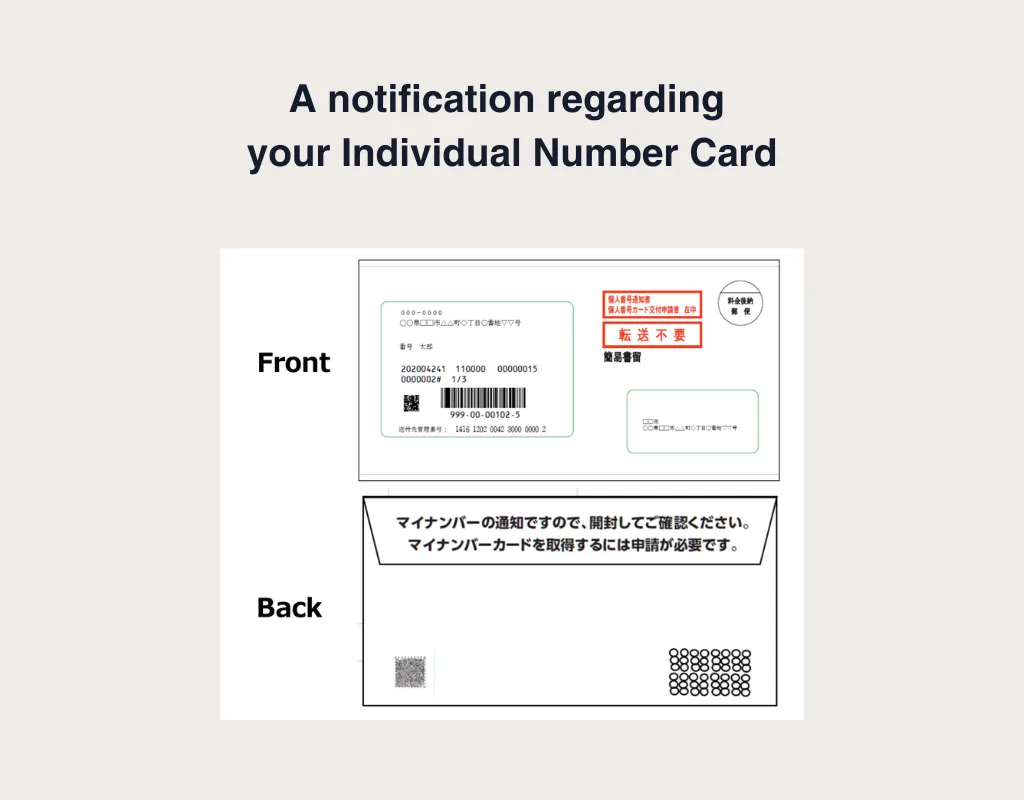
This image was created based on reference information provided by Ministry of Internal Affairs and Communications Digital Agency (PDF: https://www.kojinbango-card.go.jp/hpsv/wpmng/assets/pdf/download/pamphlet-for-foreigners-en.pdf)
2. Choose Your Application Method
Applications for a My Number Card can be submitted in several ways:
Smartphone (Japanese only)
Computer (Japanese only)
Photo booth (証明用写真機)
Postal mail
3. Complete the Application Form or Online Entry
Fill in the required information either on the application form or online. If you apply by smartphone or photo booth, you can scan the QR code printed on your notification letter to directly access the application page.
Application for issuance of the Individual Number Card – マイナンバーカード総合サイト
4. Attach a Photo
You must provide a photo for your My Number Card.
For postal applications: paste the printed photo onto the form.
For online methods: follow the instructions to upload or capture a digital photo.
5. Submit Your Application
Send the application form by post or submit the data online.
6. Receive a Pickup Notice
About one month after applying, you will receive a pickup notification postcard (交付通知書) from your municipality. Bring this postcard and your identification documents to the municipal office. In principle, the cardholder must appear in person to collect the card. If a proxy collects it, additional documents will be required.
What to bring (for the cardholder):
Pickup notification postcard
Valid ID (One valid photo ID is required, such as a driver’s license, driving history certificate (issued on or after April 1, 2012), passport, residence card, special permanent resident certificate, provisional stay permit, or temporary protection permit.)
Foreign residents are generally required to present a valid passport or residence card.
7. Set Your PIN Codes
At the municipal office, you will be asked to set PIN codes for the card’s electronic certificates:
Signature Electronic Certificate: 6–16 characters (letters and numbers)
User Verification Certificate: 4-digit number
Input Assistance PIN: 4-digit number
(You may use the same number for all if preferred.)
8. Receive Your My Number Card
Once your identity has been confirmed and your PIN codes are registered, your My Number Card Japan will be officially issued.
Chapter5: Common Mistakes and Points to Note
Important points to be aware of when it comes to the My Number Card Japan:
Obtaining a My Number Card Is Not Mandatory
While every resident in Japan with a registered address is assigned a My Number, applying for and obtaining a My Number Card is entirely optional. It is not a legal requirement, so it is possible to live in Japan without having a My Number Card.
You Must Update Your My Number Card When Your Residence Period Changes
The validity of a My Number Card is linked to the period of stay on your residence card. If your residence period is extended, you must also update your My Number Card.
When you receive a new residence card, make sure to visit your municipal office to update your My Number Card before the card’s current expiration date. If the new residence card is not issued before the My Number Card expires, there are special provisions to extend the card’s validity. Confirm the exact procedure with your local municipal office.
Chapter6: New "Special Residence Card"
On June 14, 2026, a new system will be introduced to combine the functions of your Residence Card (Zairyu Card) and My Number Card into a single card called the “Special Residence Card” (Tokutei Zairyu Card).
What will change?
One-Stop Procedures: Currently, you must visit the Immigration Bureau for residency matters and the local municipal office for My Number updates. With the new card, you can handle both at the Immigration Bureau in a single visit.
Single Chip Integration: One card will hold both your visa information and your My Number digital certificate.
Optional Choice: You can choose to keep two separate cards or switch to the integrated Special Residence Card.
Timeline:
March 24, 2025: Driver’s licenses can be integrated into My Number Cards.
December 2, 2025: Traditional health insurance cards will be phased out and replaced by the “Myna Insurance Card.”
June 14, 2026: Launch of the Special Residence Card.
Chapter7: Advice from a Certified Financial Planner
Even for foreigners, if you have a registered residence in Japan, a My Number is issued and you can optionally apply for a My Number Card Japan. Applying for the card can make daily life in Japan more convenient.
Having a My Number Card provides more than just an official form of identification. It can also be used for a wide range of situations, including:
Online administrative procedures
Visiting hospitals
Tax and public fund-related processes
One particularly convenient feature is the ability to complete residence-related procedures online. Since the My Number Card can now also be used via smartphone, you can access many functions without carrying the physical card, adding extra flexibility for your daily activities in Japan.
Chapter8: FAQ: My Number Card Japan
As a financial planner, these are some of the questions I frequently receive from clients regarding the My Number Card Japan:
Q1. Can foreigners apply for a My Number Card?
A: Yes. Any individual with a registered residence in Japan can apply for a My Number Card, including foreign residents.
Q2. How is it different from a Residence Card?
A: A Residence Card is issued under the authority of the Immigration Services Agency of Japan for mid- to long-term residents. It serves as proof of residence status and period of stay. Individuals aged 16 and older are required to carry it at all times while in Japan. Renewal requires procedures at a local immigration office.
In contrast, a My Number Card is issued under the jurisdiction of the Digital Agency through municipal offices. It serves as proof of your individual number (My Number) and as an official identification card. Any resident in Japan can optionally apply for it. It is used for a wide range of services, including administrative procedures, health insurance, and tax filings. Renewal is handled at your local municipal office.
Future Integration: According to recent legal reforms, the Residence Card and My Number Card will eventually be integrated into a single card called the “Specified Residence Card” (特定在留カード). This card is expected to be issued during either residence status renewal at the immigration office or when registering your address at a municipal office. The law was enacted in June 2024, and the integrated card is expected to be available within two years.
Source: Q&A on Integrated Residence and My Number Card | Immigration Services Agency
Q3. Can foreigners receive MyNa Points?
A: MyNa Points were a campaign providing points for creating or registering a My Number Card. As of 2025, the campaign has ended. No points are currently available for either Japanese or foreign residents.
Q4. What should I do if I lose my card?
A: If you lose your My Number Card, immediately report it to both the local police (kōban) and your municipal office. Additionally, contact the My Number Card Help Desk to suspend the card’s functions.
Foreign Language Support:
Phone: 0120-0178-27
Languages: English, Chinese, Korean, Spanish, Portuguese, Thai, Nepali, Indonesian, Vietnamese, Tagalog
English, Chinese, Korean, Spanish, Portuguese support is available 24/7
Japanese Support:
Phone: 0120-95-0178
Temporary suspension for lost cards is available 24/7 all year round
Q5. What should I do when leaving Japan?
A: If you temporarily leave Japan and later return to register your residence, your My Number remains the same, and you can continue using your My Number Card. No special procedures are required when leaving Japan.
However, it is important to keep your card safe, as it will be needed if you reapply after returning. If the card has expired or you do not plan to return, it should be returned to your municipal office.
Q: Is it mandatory to switch to the Special Residence Card in 2026?
A: No, it is not mandatory. By integrating them, it eliminates the need to visit multiple government offices when renewing your period of stay.
Chapter9: Summary
A My Number Card Japan can be obtained by any resident in Japan, including foreigners. It can be used as an official identification card, to obtain certificates such as a resident record at convenience stores, and to check personal information like medical expenses and pension records via the My Number Portal.
When registered on a smartphone, the card’s functions can be used without carrying the physical card, making it highly convenient. In the near future, the planned integration with the Residence Card will make the system even more efficient, allowing for smoother access to administrative and personal services in Japan.
* This article is provided for general informational purposes only and does not constitute individual financial, tax, or legal advice. While reviewed by a certified financial planner, readers are encouraged to consult their own advisors before making decisions. Belonging JAPAN is not affiliated with or endorsed by any financial institution mentioned. Information such as fees and regulations is accurate as of September 2025 but may change; please verify details with official sources.

2 comments
Thank you for this comprehensive guide on My Number Cards! I have a question about the integration with medical insurance that might help other readers. I noticed you mentioned the MyNa Health Card functionality, but I’m curious about how this works for foreign residents who might have additional private international health insurance. Sorry for including a link, but I found this detailed guide about medical insurance options in Japan https://pillintrip.com/ru/article/medical-insurance-in-japan-your-complete-guide-for-tourists-relocators-and-digital-nomads that discusses various insurance scenarios. Could you clarify how the My Number Card’s health insurance features interact with supplementary private insurance policies that many expats maintain? Does the system automatically coordinate benefits, or do patients need to manage multiple cards/claims separately?
Thank you for your comment! To answer your question, Japan’s public health insurance system and private medical insurance don’t coordinate with each other. Private insurance generally covers out-of-pocket costs under Japan’s health insurance (usually 10–30%) or treatments that aren’t covered. If a treatment is included in your policy, the insurance company will pay the specified benefit.
Also, private insurance information isn’t linked to Japan’s public health insurance system or the My Number Portal. So, your My Number Card and private insurance card need to be managed separately.
I think many people have questions about the MyNa Health Card, so we’re currently working on an article about this topic. We hope it will be helpful! We have also test-launched a free online consultation where you can ask questions directly to a financial planner. It is conducted in English, so if you’re interested, please feel free to make a reservation! Here is a link for it; https://www.belongingjapan.com/how-to-guide/exclusive-financial-planning-consultation/
Comments are closed.