


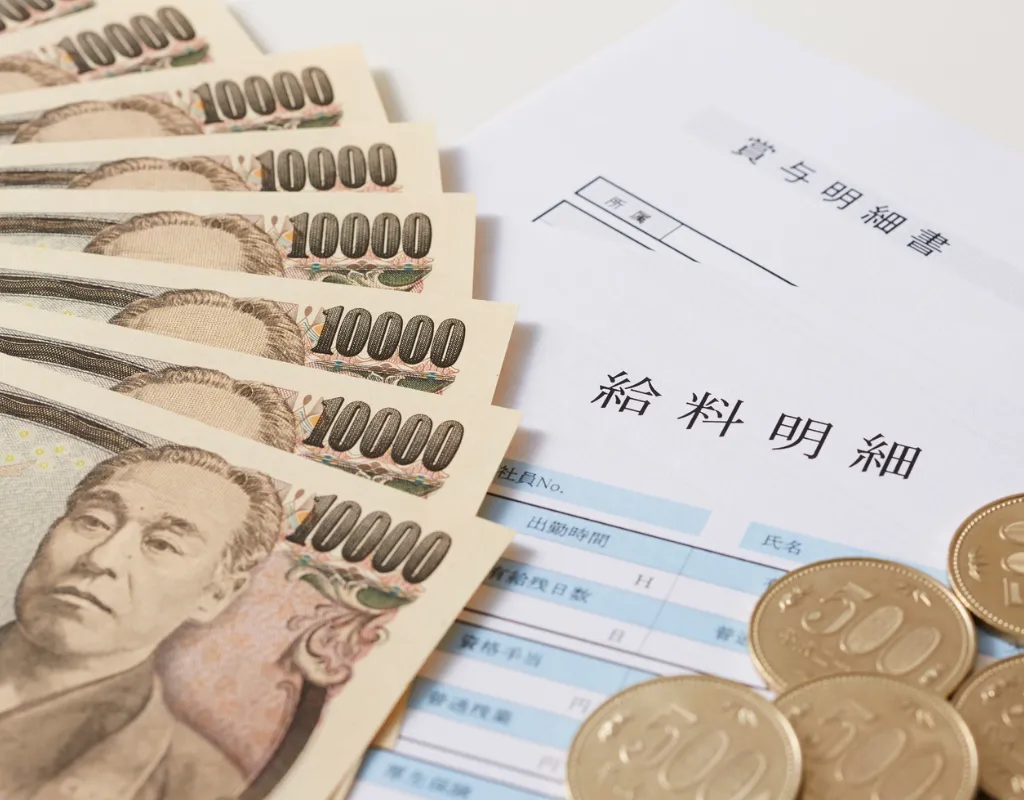
When working in Japan, the payslip issued by an employer is an essential document for understanding income. It not only shows salary details, but also provides important information about taxes paid and social insurance premiums enrolled in. Because a payslip contains key information related to daily life and financial stability in Japan, knowing how to read it is extremely useful.
In this article, Lili Katoh, a Certified Financial Planner (CFP®), clearly explains how to read a Japanese payslip in an easy-to-understand way.
About the Supervisor & Writer
Certified Financial Planner®
Founder of Money Step Office Inc.
Lili Katoh specializes in insurance, life planning, and asset management. She is a Health Management Expert Advisor and author of “Setai Nenshū 1000 Man En” and “Gattsuri Tamaru Chokin Recipe”. Born in California, USA, she brings international insight to Japanese financial planning.
Table of Contents
Chapter 1: What Is a Payslip?
1.1. What Is a Payslip?
A payslip(給与明細 kyūyo meisai) is an official document issued by an employer that details an employee’s salary. In Japan, companies that employ full-time employees, part-time workers, and temporary staff are legally required to issue a payslip. Payslips are usually issued on each payday, most commonly once a month, and may be provided either in paper form or as electronic data.
A Japanese payslip shows not only the salary paid, but also important deductions (控除 kōjo), including taxes and social insurance premiums(社会保険料 shakai hokenryō), which play a key role in everyday life and financial planning in Japan.
1.2. Structure of a Japanese Payslip
Most Japanese payslips follow a similar structure, even though the format may vary by employer.
1. Earnings section(支給欄 shikyū-ran)
Shows the money paid by the company.
2. Deductions section(控除欄 kōjo-ran)
Shows the money taken out of the salary.
3. Net pay(差引支給額 sashihiki shikyūgaku)
The final amount actually received after deductions.
4. Attendance section(勤怠欄 kintai-ran)
May be included by some employers.
Shows days worked or hours worked.

Created based on a diagram from the Ministry of Health, Labour and Welfare: https://www.check-roudou.mhlw.go.jp/pdf/shakaijinmukeshiryou_2_1.pdf)
Chapter 2: How to Read the “Payment” Section on a Payslip?
The earnings section(支給欄 shikyū-ran) of a payslip shows a breakdown of the money paid by the employer. The main items are listed below.
Base Salary(基本給 kihonkyū)
This is the base salary amount.
In most cases, it matches the amount stated in the employment contract.
Allowances(手当 teate)
If the company provides financial support in addition to the base salary, it is paid as an allowance(手当 teate).
The types and amounts of allowances vary depending on the employer, job position, and family situation.
Common examples of allowances include:
Overtime Allowance(残業手当 zangyō teate)
Paid for work performed beyond regular working hours.
It may also be listed as Overtime Pay(時間外手当 jikan-gai teate).Holiday Work Allowance(休日出勤手当 kyūjitsu shukkin teate)
Paid when an employee works on a legally designated holiday due to business needs.Commuting Allowance(通勤手当 tsūkin teate)
Covers transportation costs for commuting to work.Position Allowance(役職手当 yakushoku teate)
Paid based on job title or level of responsibility.Qualification Allowance(資格手当 shikaku teate)
Paid for holding certain qualifications or passing certification exams.Housing Allowance(住宅手当 jūtaku teate)
Provided to support housing costs such as rent or a home loan.Family Allowance(家族手当 kazoku teate)
Paid to employees supporting family members.
It may also be listed as Spouse Allowance(配偶者手当) or Dependent Allowance(扶養手当).
Total Gross Pay(総支給額 sō-shikyūgaku)
The total gross pay(総支給額 sō-shikyūgaku) is the total amount paid by the employer.
It is calculated by adding the base salary and all allowances.

Chapter 3: What Are “Deductions” on a Payslip?
The deductions section(控除欄 kōjo-ran) of a payslip shows a breakdown of the amounts that are subtracted from the salary paid by the employer.
What Are Deductions?(控除 kōjo)
The word 控除 (kōjo) means “to deduct.”
In Japan, when working as a salary earner—such as a full-time employee or part-time worker—certain taxes and social insurance premiums are automatically deducted from the salary before it is paid. This process is commonly referred to as payroll withholding, or 天引き (tenbiki) in Japanese.
The taxes and social insurance premiums deducted from the salary are paid by the employer on behalf of the employee to the national government or local authorities. This system is called withholding at source(源泉徴収 gensen chōshū).
The main types of deductions listed on a Japanese payslip are explained below.
Related Post
1. Social Insurance Premiums(社会保険料)
Health Insurance Premium(健康保険料)
- This is the premium paid by people enrolled in Japan’s public health insurance system. The type of health insurance plan varies by employer (such as a health insurance society or Japan Health Insurance Association), but premiums are calculated based on income and paid monthly.
- The cost is shared equally between the employer and the employee, so only half of the total premium is deducted from the payslip.
Long-Term Care Insurance Premium(介護保険料) (Age 40 and over)
- People aged 40 and over are required to enroll in Japan’s long-term care insurance system in addition to health insurance.
- The premium amount depends on income and the insurance system joined.
- As with health insurance, the cost is split equally between the employer and employee, and only half of the premium is deducted from the payslip.
Employees’ Pension Insurance Premium(厚生年金保険料)
- Employees working for companies enrolled in the social insurance system are also required to join Japan’s public pension system.
- For company employees, this is classified as Employees’ Pension Insurance.
- Premiums are calculated based on income and paid monthly.
- The cost is shared equally between the employer and employee, and half of the premium is deducted from the salary.
Employment Insurance Premium(雇用保険料)
- Employment insurance provides support in situations such as unemployment, job training, and childcare leave.
- In Japan, all businesses that employ workers are required to enroll in employment insurance. The insurance rate varies depending on the type of business.
- For general businesses, the employment insurance rate is 1.45% of total monthly wages.
Of this amount, 0.55% is paid by the employee and is deducted from the payslip.
Related Post

2. Taxes(税金)
Taxes applied to salary income are also deducted from the payslip.
The two main taxes deducted are income tax and resident tax.
Income Tax(所得税)
Income tax is a national tax imposed on people earning above a certain income level.
Japan uses a progressive tax system, meaning the tax rate increases as income rises.
Each month, income tax is withheld based on the estimated annual income, calculated from the monthly salary.
Resident Tax(住民税)
Resident tax is a local tax paid to the municipality where the employee lives.
It is calculated based on the previous year’s income.
For this reason, people who have recently arrived in Japan or are in their first year of employment often do not have resident tax deducted from their salary.
3. Other Payroll Deductions Through Company Programs
If an employee participates in savings or insurance programs offered by the employer, the related amounts may also be deducted from the salary. Available programs vary by company and employment type.
Company Savings Plan(財形貯蓄)
A savings program that allows employees to accumulate savings through payroll deductions from monthly salary or bonuses.
Corporate Defined Contribution Pension Plan(企業型確定拠出年金)
A pension plan often included as part of a retirement benefit system.
In most cases, contributions are paid entirely by the employer and are not deducted from salary.
However, under optional arrangements such as matching contributions, employees may choose to make additional contributions through payroll deductions.
Group Insurance(団体保険)
Some employers offer optional group life or medical insurance plans for employees.
If enrolled, the insurance premiums may be deducted from the payslip.
Union Dues(組合費)
If the workplace has a labor union, union dues may be deducted from the salary based on union agreements.
4. Total Deductions(控除額合計)
The total amount of all deductions—including social insurance premiums, taxes, and other items—is shown as the total deductions on the payslip.

Your take-home pay is calculated using this formula:
Total Gross Pay(総支給額合計)
− Total Deductions(控除額合計)
= Net Pay(差引支給額)
What Each Item Means
- Total Gross Pay(総支給額合計)
The total amount paid by your company before any deductions. - Total Deductions(控除額合計)
The total amount subtracted for taxes, social insurance, and other deductions. - Net Pay(差引支給額)
The final amount transferred to your bank account on payday.
This is your monthly take-home income.
Chapter 5: Common Misunderstanding
A document that is often confused with a payslip is the Withholding Tax Certificate(源泉徴収票 gensen chōshūhyō).
However, a payslip and a withholding tax certificate are different documents.
What Is a Withholding Tax Certificate?
A withholding tax certificate is a document issued once a year after the year-end tax adjustment in December.
A payslip is issued every month.
A withholding tax certificate is issued once per year.
Both documents include information about:
Salary amounts paid
Taxes and social insurance premiums deducted
However, their purposes are different.
A payslip shows detailed breakdowns of:
Monthly salary
Allowances
Overtime pay
Individual deductions
In contrast, a withholding tax certificate does not show detailed monthly breakdowns.
Instead, it focuses on annual tax information, including:
Total salary received during the year
Total income tax withheld
Details of income deductions
This is because the withholding tax certificate is used to confirm your annual income tax amount and may be submitted to the tax office when necessary.
Related Post
What Is the Year-End Tax Adjustment?
The year-end tax adjustment(年末調整 nenmatsu chōsei) is the system in which your employer recalculates your income tax based on your actual annual income and deductions.
Each month, income tax is withheld from your salary based on your estimated annual income.
This estimated tax amount appears on your monthly payslip.
However, Japan’s tax system includes various income deductions(所得控除), such as:
Supporting a spouse or dependent family members
Paying social insurance premiums (health insurance, national pension, employees’ pension, etc.)
Paying life insurance premiums
Paying large medical expenses
After applying these deductions, the actual amount of income tax you owe for the year may change.
At the end of the year, your employer adjusts the difference between:
The total income tax already withheld during the year, and
The correct income tax amount calculated after applying deductions
This adjustment is called the year-end tax adjustment.
What Happens After the Adjustment?
If the correct annual income tax amount is:
Higher than what was already withheld
→ The remaining balance is collected, usually from your December salary.Lower than what was withheld
→ The overpaid amount is refunded to you.
The results of this adjustment, including any additional payment or refund, are reflected on your withholding tax certificate.
Chapter6: Advice from a Financial Planner
When you receive your payslip, first check the Net Pay(差引支給額).
By doing so, you can immediately confirm your take-home income for the month.
If you have time, also review the details in:
The Earnings section(支給欄)
The Deductions section(控除欄)
Understanding:
How much you worked
What types of payments you received
What deductions were applied
can help you better manage and improve your household finances.
Regularly checking your payslip allows you to stay aware of your income, taxes, and social insurance contributions, which is an important step toward financial stability.
Chapter7: Frequently Asked Questions (FAQ)
As a Certified Financial Planner, many questions have been received about the payslip in Japan. The most common questions and clear, practical answers are summarized below.
Read the full FAQ from the button below—follow on Substack and join the community.
Q1. When will I receive my payslip?
Q2. Are “deduction” (控除) and “withholding” (源泉徴収) the same thing?
Q3. Which year’s income is resident tax deducted from?
Q4. If I contribute to iDeCo or NISA, will it appear on my payslip?
Q5. Should I keep my payslips?
Q6. Do I need payslips to claim the lump-sum withdrawal payment of pension when leaving Japan?
Chapter8: Summary
A payslip is an important document that clearly shows how much your employer pays you and how much is deducted for taxes and social insurance.
In the earnings section, you can see the breakdown of your base salary and any allowances.
In the deductions section, you can check amounts withheld for health insurance, employees’ pension, employment insurance, income tax, resident tax, and other items.
The amount left after all deductions — shown as Net Pay (差引支給額) — is the actual amount you take home.
Reviewing your payslip each month helps you stay aware of changes in your income and quickly catch any possible errors in deductions.
* This article is provided for general informational purposes only and does not constitute individual financial, tax, or legal advice. While reviewed by a certified financial planner, readers are encouraged to consult their own advisors before making decisions. Belonging JAPAN is not affiliated with or endorsed by any financial institution mentioned. Information such as fees and regulations is accurate as of February 2026 but may change; please verify details with official sources.