


Surviving rainy season in Japan is all about preparation. Known as tsuyu (梅雨), rainy season in Japan is unlike anything most foreigners have experienced before — it is not just weeks of steady drizzle, but a combination of intense guerrilla rainstorms, 80%+ humidity, mould risk, and on clear days, temperatures approaching 40°C. This definitive guide covers everything foreign residents need to get through tsuyu comfortably, from essential products to practical Japanese life hacks.
For the latest 2026 regional forecast and JMA start dates, see: Japan Rainy Season 2026: Forecast & Dates
Table of Contents
Chapter 1: What Makes Rainy Season in Japan So Challenging?
Rainy season in Japan — tsuyu (梅雨) — arrives as a stationary weather front that parks itself over the archipelago for 4–6 weeks, typically from early June to mid-July in most of Honshu. It is caused by warm, humid Pacific air colliding with cooler air from the north, bringing prolonged rainfall, grey skies, and relentless humidity.
But surviving rainy season in Japan in 2026 means dealing with something beyond classic tsuyu. Modern Japanese summers increasingly bring guerrilla rainstorms (ゲリラ豪雨) — sudden, highly localised downpours that can drench you in minutes and that weather forecasts often fail to predict. On dry days between storms, temperatures can climb close to 40°C. One moment you need an umbrella, the next you need sun protection.
Here is what you are up against:
- Guerrilla rainstorms — intense and unpredictable. The person 200 metres away may stay completely dry.
- Humidity above 80% — mould can appear on walls, clothing, and food within days.
- Laundry that won’t dry — clothes can take 2–3 times longer indoors.
- Near-40°C heat on clear days — UV protection is just as important as rain protection.
Key Japanese Words
| Japanese | Romaji | Hiragana | English |
|---|---|---|---|
|
梅雨 |
tsuyu |
つゆ |
rainy season |
|
梅雨入り |
tsuyu iri |
つゆいり |
the onset of the rainy season |
|
梅雨明け |
tsuyu ake |
つゆあけ |
the end of the rainy season |
|
梅雨前線 |
baiu zensen |
ばいうぜんせん |
the rainy season front, which is the weather front that causes the rainy season’s precipitation |
|
天気予報 |
tenki yohō |
てんきよほう |
weather forecast |

Rainy season in Japan does not arrive all at once — it moves gradually from south to north over several weeks. Okinawa typically enters tsuyu in early May, while Tokyo and central Honshu follow in early June, and Tohoku in mid-June. Hokkaido is the only major island without an officially designated rainy season.
For real-time 2026 start and end dates by region, updated as the Japan Meteorological Agency announces:
Chapter 3: How to Prepare for Rainy Season Japan
Step1. Install Essential Mobile Apps
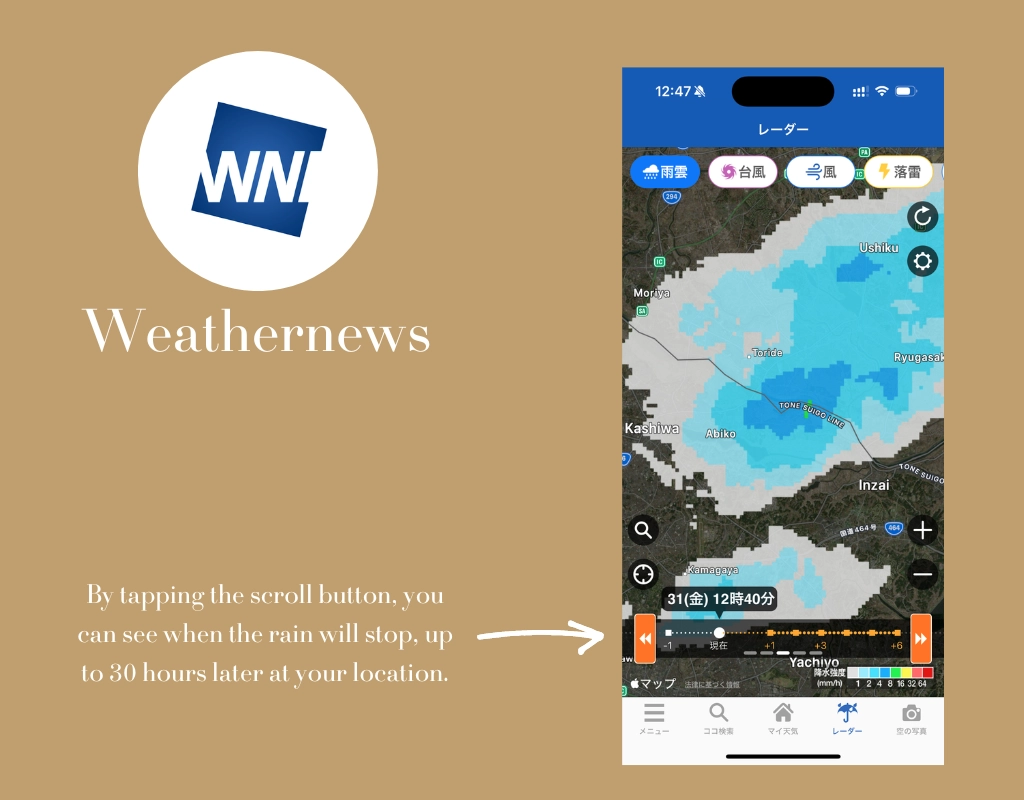
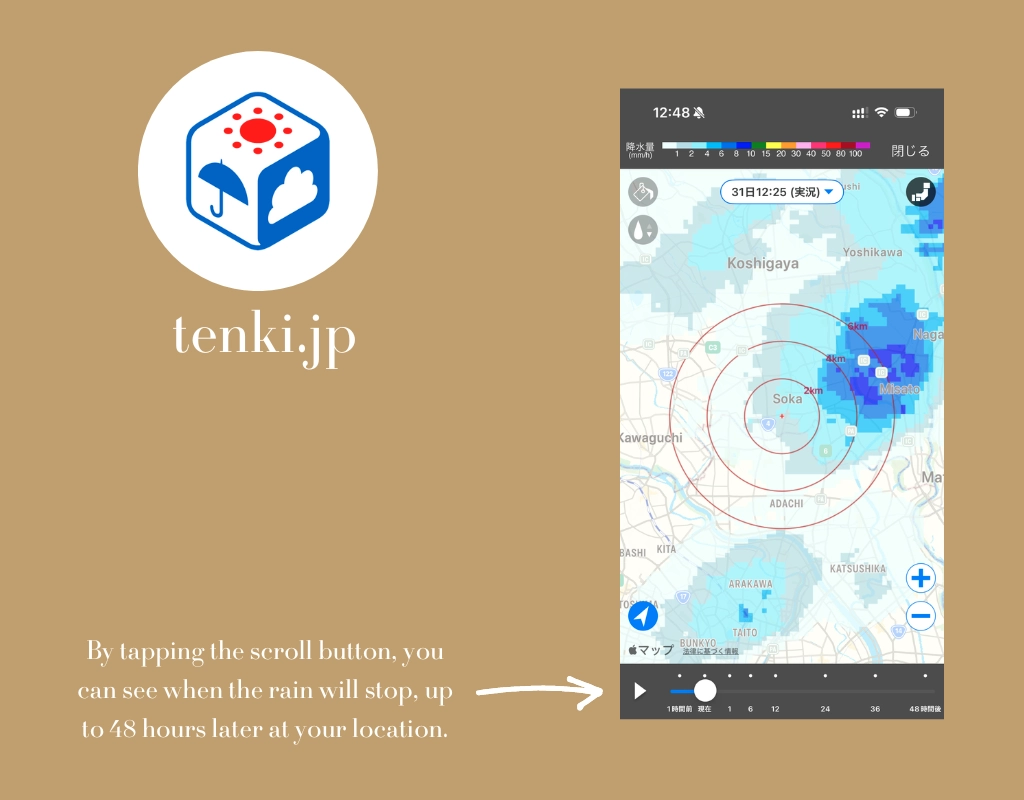
It’s useful to have an app with a rain cloud radar function, especially during the rainy season Japan experiences each year. This is particularly handy during sudden downpours, as the rain often stops just a few minutes later. It’s common to arrive at the station, walk through heavy rain, and then find it barely raining five minutes later. Having an app like the ones mentioned below can be very convenient. Both apps provide weather updates for your current location every 5 to 10 minutes.
Weathernews
A weather forecast app with over 42 million downloads.
tenki.jp
An official weather forecast app from the Japan Meteorological Association.
Weather experts from all over Japan, equipped with specialized knowledge, work around the clock to predict weather changes and deliver the latest weather information.
Step2. Prepare Essential Items
1. Get the Right Umbrella — 晴雨兼用 is the Key
The single most important purchase for surviving rainy season in Japan is an umbrella — but not just any umbrella. The smart choice is a 晴雨兼用 (sun and rain dual-use) umbrella.
Here is why: during rainy season in Japan, you face two enemies on the same day. A guerrilla rainstorm can strike with zero warning at 10am, and by noon the sky is clear with temperatures near 40°C. A 晴雨兼用 umbrella handles both — it blocks UV rays on sunny days just as effectively as it repels rain. It is the one umbrella you need.
One more thing: it is no longer just women who carry parasols in Japan. Men increasingly use them during summer — and for good reason. The cultural shift is real, and the UV protection is worth it.
Alwgreen’s folding umbrella is one of the most popular 晴雨兼用 options on Amazon Japan — and for good reason. It is JIS-certified (Japan Industrial Standard), meaning its UV and light-blocking performance has been independently verified to standards 100 times stricter than general industry benchmarks. Key features:
- 100% UV cut & complete light blocking — protects skin and reduces body temperature by up to 15°C when opened, using German-imported Radi-Cool fabric
- 149g — exceptionally lightweight; you will barely notice it in your bag
- Pocket-sized — folds compactly for daily commutes
- Wind-resistant & water-repellent — handles Japan’s guerrilla rainstorms as well as sunny days
If you prefer a larger umbrella that keeps bags and shoulders dry during Japan’s heavy guerrilla rainstorms, this 12-rib extra-large model is the answer. Key features:
- Extra-large canopy — 108cm diameter when open, comfortably fitting two adults; ideal if you carry a backpack during your commute
- 12-rib frame — significantly sturdier than a standard 8-rib umbrella; resists strong winds and heavy rain without bending
- Reverse folding design — closes so the wet side folds inward, keeping your clothes and bag dry when collapsing the umbrella in a packed train or car
- One-touch auto open/close — convenient when hands are full
- Teflon coating — water beads and rolls off instantly; a quick shake removes most moisture
- UV cut & heat blocking — 晴雨兼用 for sunny days too
- Typhoon-ready — built for Japan’s rainy season and beyond
- Comes with a storage pouch; suitable for men and women
Step 3: Protect Shoes and Bags with Waterproof Spray
Even a good umbrella cannot protect everything. Surviving rainy season in Japan means keeping your shoes dry — soaked shoes on a 30-minute commute are miserable. A waterproof spray applied to leather shoes, sneakers, bags, and outerwear before tsuyu starts adds an invisible protective layer that repels water and prevents stains.
Ingredients: Features a hybrid formula of fluorine and silicone for powerful water and stain repellency with long-lasting performance—130% longer durability compared to conventional products.
Waterproof Performance: Proven to deliver top-level water and oil repellency on five key materials (polyester, broadcloth, genuine leather, cotton, etc.) through comparative tests with leading sprays on the market.
Safety: Free from crosslinking agents, significantly reducing the risk of discoloration such as black items turning white or white items yellowing.
Antibacterial Properties: Offers deodorizing, disinfecting, and antibacterial protection—removes odor-causing microbes like Moraxella and keeps your favorite items clean and fresh.
Applicable Materials: Suitable for most materials except silk, vinyl, plastic, and items that require dry cleaning. Always test on an inconspicuous area before full use.
- Ingredients: Formulated with high-concentration fluorine for ultra water-repellency and enhanced waterproof and oil-repellent performance, surpassing conventional sprays.
- Waterproof Performance:
Delivers powerful water and oil repellency while maintaining breathability—perfect for various materials including leather, suede, mesh, and nylon, protecting them without compromising their texture or ventilation. - Safety:
Silicone-free formula prevents surface coating that blocks airflow, reducing risks of material degradation, overheating, moisture buildup, and odor—ideal for clothing and outdoor wear. - Applicable Materials: Suitable for leather, Suede, Mesh fabrics (sneakers), and Nylon (outdoor wear, bags.
Step4. Anti-Fog Cleaning Cloth for Glasses
One of the unpleasant aspects of the rainy season, besides the rain, is the humidity. For example, you might have experienced your glasses fogging up when you suddenly enter a train or an indoor space. Using anti-fog lenses is one solution, and anti-fog cloths, like the ones mentioned below, might also be useful. There are spray types as well, but if you need to wipe your glasses several times a day anyway, using an anti-fog cloth could provide the added benefit of preventing fogging.
Step 5: Control Humidity at Home — Mould is the Real Enemy
As mentioned above, one of the troublesome aspects of the rainy season is the mold that can form due to high humidity. Most air conditioners in Japan have a dehumidifying function, so it’s important to use it. Additionally, it’s recommended to place moisture absorbers in areas where humidity tends to accumulate, such as shoe cabinets and closets.
1. Moisture absorbers
First, let’s start with the typical types. When placed in humid areas, you might notice water collecting in just a few days. Most packages are white, but this version uses charcoal, which is known to absorb unpleasant odors during the rainy season.
2. Moisture absorbers to hang in the closet
If you prefer to hang it in the closet, here is another type.
3. Clothes Drying Dehumidifier
If you prefer not to use the drying function on your washing machine, a dehumidifier with a clothes-drying feature, like the one below, might be useful. When drying clothes indoors, it can dry about 2 kilograms of clothing in about 3 hours. Some models can dry the same amount in just 1 hour. Additionally, Sharp’s unique deodorizing function can remove sweat and odors from items like suits that you would typically take to the cleaners.
4. Dryer For The Mattress And Duvet
Furthermore, when the humidity is high and it rains frequently, drying a mattress and a duvet can be challenging. For example, you can dry them in a bathroom with a dryer function, but it’s a hassle to carry them there. A dryer that warms the mattress and duvet with warm air and removes moisture is convenient. I also own one, and for example, the Iris Ohyama dryer has a dust mite mode that uses high-temperature air to tackle dust mites while drying. It can be used year-round, with settings to warm the mattress and duvet in winter or to dry them in summer. Additionally, the nozzle can be used to dry shoes, making it useful for more than just mattresses and duvets.
5. Umbrella Stands
Finally, let’s talk about umbrella stands. When it rains almost every day, family members bring home wet umbrellas, which can make the entrance look cluttered. Especially in Japanese homes, where the entrance space is not very large, using a space-efficient umbrella stand like the magnetic type that attaches to the door can be very practical.